Once more Razib Khan has a very good post about "race" (Gene Expression) concerning a discussion at the middle-left journal "The New Republic".
A commenter, P.G. Hiqman, at "Gene Expression" has made this posting there, that I think is worth reading, because it gives a good overview of the debate:
I am not currently a subscriber to TNR, nevertheless this the message that I would post there if I were a subscriber.---
In his primary article Mr. Chowkwanyun made a couple of fleeting references to Francis Galton and Franz Boas, this is appropriate since they are the most influential developers of the opposing Galtonian (Hereditarian/Essentialist) and Boasian (Environmentalist/Cultural-causation) theories pertaining to inter-ethnoracial group differences in mental ability.
The Galtonian theory was promulgated first at the University of London (sometimes it is referred to as the “London school of differential psychology” to contrast it with the Environmentalist American behaviorist school founded by John Watson and B.F. Skinner).
The Galtonian movement included figures such as Karl Pearson, Charles Spearman, Cyril Burt (yes I am aware that years after his death he was accused of faking some of his research--but more recent research has possibly absolved him of this charge and in fact numerous more recent twin studies have shown that the heritability of intelligence as measured in adults is about 70 to 80 % due to genes--which is what Burt originally claimed--thus even if some of Burt’s data were faked subsequent research has now validated his major claim), Philip Vernon, Raymond Cattell and Hans Eysenck. More recent champions of the Galtonian view have included Arthur Jensen, Thomas Bouchard, J.P. Rushton, Richard Herrnstein, Charles Murray, Richard Lynn, and Linda Gottfredson.
Many pro-Galtonian articles including a recent 2005 review article “THIRTY YEARS OF RESEARCH ON RACE DIFFERENCES IN COGNITIVE ABILITY” by Jensen and Rushton can be found at Gottfredson’s (http://www.udel.edu/educ/gottfredson/reprints/ index.html
) and Rushton’s (http://psychology.uwo.ca/faculty/ rushton_pubs.htm
) websites.
In the field of anthropology, prominent Galtonians have included Carleton Coon, Vincent Sarich, and Henry Harpending. Also many people associated with sociobiology such as William Hamilton, Edward O. Wilson, and Steven Pinker been rather receptive toward the considering the Galtonian viewpoint and this perhaps explains why Boasians such as Lewontin and Gould were so critical of Sociobiology.
Anti-Galtonian Environmentalist views had been espoused by earlier figures such as Léonce Pierre Manouvrier in France and Rudolf Virchow and Adolf Bastian in Germany (actually they were both mentors of Boas), but the man who really turned the world’s intellectual tide against the Galtonian view was the German Jew Franz Boaz. After earning a PhD in Physics at Kiel, Boas soon became interested in primitive peoples (he studied the Eskimos on Baffin Island). Influenced by Virchow and Bastian, Boas convinced himself that cultural differences--but not innate essential differences--were the cause for the vast differences observed between primitive savage peoples and advanced civilized peoples. Boas eventually moved to America and became the most influential anthropologist of the 20th Century. In the post war era, Boasians rapidly came to dominate anthropology and all of the other social sciences. Prominent Boasians include figures such as Melville Herskovits, Ruth Benedict, Margaret Mead, Otto Klineberg, Horace Mann Bond, Ashley Montagu, Sherwood Washburn, Gunnar Myrdal, Gordon Allport, Ned Block, Richard Lewontin, Stephen Jay Gould, Leon Kamin, Claude Steele, Jonathan Marks, Jared Diamond, Richard Nisbett, James Flynn, Abigail Thernstrom, Howard Gardner, and Robert Sternberg.
Mr. Chowkwanyun implied that The Bell Curve was universally denounced by the academic establishment, but actually this is not true. Herrnstein’s and Murray’s views were roundly denounced by the Boasian academic establishment but about fifty of the most prominent professors in the academic disciplines that are actually most closely concerned with the subject (i.e. differential psychology/psychometrics) actually published a statement largely agreeing with the viewpoints of The Bell Curve (a letter published in 1994 Wall Street Journal now available at Gottfredson’s website). Thus it appears that many of the academics who truly are experts on the topic of IQ actually find the Galtonian perspective to be more plausible than the Boasian view.
Ethnic and racial group differences in IQ and socioeconomic status are not limited just to the American white/black issue. Some groups such as East Asians (Han Chinese, Koreans, and Japanese) and Jews when compared to Gentile whites have significantly higher average IQs and SES. Conversely some groups such as Native Americans, Hispanics, and African Americans have significantly lower average IQs and SES compared to Gentile whites. These empirical facts greatly distress the Boasians who fervently hope for a fantasy utopian world in which all ethnic and racial groups will manage to exhibit the same average IQs and SES. Boasians often extol the virtue of appreciating ethnic diversity but they are inconsistent in that they require people to steadfastly ignore the immense ethnic diversity that exists with regard to IQ. All true Boasians long for the day when all ethnic groups will be represented equally in prestigious positions of business ownership and at elite universities. They of course gloss over the inconvenient fact that this would greatly impinge on the interests of members of high-IQ minority groups (e.g. Jews and East Asians) who often are represented at elite universities and in elite professions at levels 5 to 10 fold higher than their demographic proportion would justify under a true Boasian model of fair equity. Are these Boasian proponents of affirmative action really ready to inform more than 80% of Jews and East Asians that they should curtail their career goals in order to avoid garnering an “unfairly” large proportion of elite job positions? Because in order to be consistent, strict Boasians such as Mr. Chowkwanyun must insist that these elite jobs be evenly distributed amongst all ethnic/racial groups! Is Mr. Chowkwanyun satisfied with the ethnic/racial make-up of his own history department at Penn? Or does his department resemble most departments at elite universities wherein certain high IQ-ethnoracial groups such as Jews and Asians occupy about 30 to 60% of the positions even though their “fair” demographic proportion (according to a truly Boasian sense of fairness) is a fraction about 5 to 10 fold lower. In contrast modern Galtonians do not believe in unfairly discriminating against individuals, instead Galtonians have the attitude that if some ethnic groups are more talented or more intelligent and thus are better suited for certain jobs then it is no problem if they gain a huge proportion of the jobs for which they are well suited.
Several prominent experts on IQ and genetics (John Defries, Robert Plomin, Ian Deary and others) have shown that the same genes that influence variation in IQ also influence variation in academic achievement--particularly on mathematics tests Plomin calls these genes that influence both intelligence and academic prowess the “generalist genes for g” (the scientific notation for the general intelligence factor is “g”). Thus to Galtonians it is no surprise that black American students invariably perform about one standard deviation lower than whites on math exams because of course all social scientists realize that black Americans have IQs that are about one standard deviation lower than white Americans. This of course engenders immense consternation in the Boasian-dominated education and social science establishments which continually demand that the black/white academic achievement gap be closed because according to the Boasian establishment everyone knows the academic achievement gap is entirely due to racism and certainly not due to ethnic genetic diversity.
Thomas Sowell of Stanford’s Hoover Institute and Amy Chua of Yale Law (she is one of Justin Shubow’s professors?) found that conflict and resentment associated with inter-ethnic disparities in wealth and academic achievement are not just limited to the USA but instead are found world wide where ever talented minority groups dominate the elite positions in business and academia (e.g. high castes in India, Jews in Russia, Caucasians in Latin America, Arabs and Indians in Africa, and Indians and in particular ethnic-Han Chinese in Malaysia, Indonesia, Philippines and Southeast Asia). As Gottfredson pointed out in her 2005 paper “What if the Hereditarian hypothesis is true”, many victims of genocide and mob violence are actually members of the higher achieving minority group. These higher achieving minority groups probably possess higher innate IQs and are often victimized by the lower IQ majority indigenous group members who resent them because in accordance with popular modern Boasian principles they can not let themselves believe that the higher achieving minority group members (due to their higher innate intelligence) are deserving of their higher proportion of elite positions in business, academia and government; thus the lower-IQ majority group lashes out at the higher achieving group. The higher achieving minority groups then become victims of violence (e.g. white Zimbabwean farmers and Han Chinese business owners in Malaysia and Indonesia) and sometimes even genocide (e.g. Armenians in Turkey, Jews in Axis Europe, Ibo in Nigeria, educated Cambodians during Pol Pot, and recently Tutsis in Rwanda).
(...)
Given that Caltech Southern California is one of the most elite Math/Tech schools in the world, I would thus estimate that Caltech math majors have IQs in the range of 145 and above (i.e. over three standard deviations higher than the white mean of IQ 100). (...) 31 Californians who earned perfect scores on the 1999 statewide Mathematics competition (http://www.mathleague.com/reports/1999_00/ CA5.HTM). Examination of the California state academic achievement math test scores shows that every year ethnically-Chinese students on average perform at a level about 0.8 standard deviation higher than white students (http://star.cde.ca.gov/star2006/index.asp
); thus indicating an average IQ of 112 for the Californian Chinese population (15 points on the IQ scale correspond to a one standard deviation difference on cognitive test results). Of note, regarding the math test (...), one can conclude from examining the names of those thirty other ultra-high IQ youths with perfect test scores that about 75% appear to be of Asian or Jewish ethnicity. Of course this is exactly as would be predicted by Galtonian theory. In contrast, Boasian theory ludicrously predicts that if gentile white, black or Hispanic children were raised in Jewish or Asian home environments then they would be just as intelligent as the Jewish and Asian youth because Boasians believe that ethnic and racial differences in IQ are transmitted via cultural differences and not via genetic differences. How many of you people really believe that? In fact during the past couple of decades numerous studies from around the world in the fields of social psychology and psychometrics have found that the home environment (called the shared environment by psychologists) actually has no influence whatsoever on variation in adult IQ when the family genetic transmission effects are accounted for. In addition, and highly damning to the Boasian theory, Weinberg and Scarr actually performed a study in Minnesota in which white, black and half black-half white infants were adopted into upper middle class white homes. When the adoptees were young children there was some evidence that the higher IQ white home environment was possibly raising their IQs; however as the adopted children grew into adulthood the black adoptees’ IQs decreased down to the same low levels as the IQs of other Minnesotan blacks and the black/white mixed race children showed IQs intermediate between the black and white norms; again exactly as would be predicted by Galtonian theory and exactly the opposite of what Boasian theory would predict.
Mr. Chowkwanyun should probably continue to remain ignorant of ethnoracial genetic science and psychometrics because if he ever became at all knowledgeable about human genomics, cognitive neuroscience, and psychometric research then doubtless someone with his high intelligence would very quickly grasp the fact that Jensen and the other modern Galtonians are really on the correct scientific course in their brave efforts to gain a true understanding of our world’s ethnoracial diversity as pertains to differences in mental ability and in socioeconomic status. So please Mr. Chowkwanyun, for your sake, so that you do not have to execute an embarrassing turnaround in your view point, please continue to prevent yourself from ever studying the books and articles of Galtonians such as Arthur Jensen, Richard Herrnstein, Charles Murray, Robert Plomin, Ian Deary, and Linda Gottfredson. Far safer and more comforting for you to remain a puerile ignoramus and continue to mindlessly spout tired old Boasian cliches that are politically correct but scientifically nonsensical.
___________________________________________
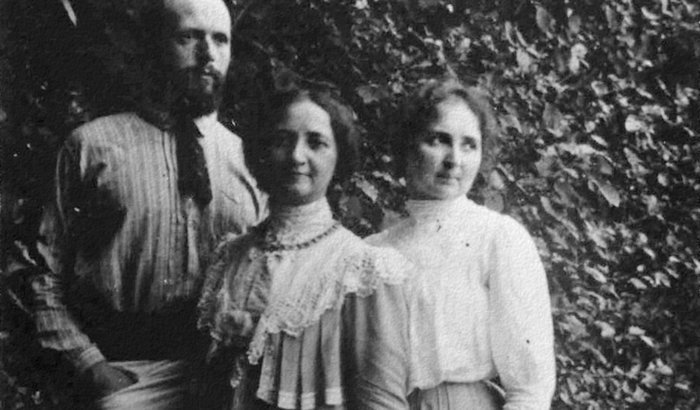 |
| Abb. 1: Translaters of Francis Galton's "Hereditary Genius" into German 1910 (1): Anna Schapire-Neurath and Otto Neurath |
A commenter, P.G. Hiqman, at "Gene Expression" has made this posting there, that I think is worth reading, because it gives a good overview of the debate:
I am not currently a subscriber to TNR, nevertheless this the message that I would post there if I were a subscriber.---
In his primary article Mr. Chowkwanyun made a couple of fleeting references to Francis Galton and Franz Boas, this is appropriate since they are the most influential developers of the opposing Galtonian (Hereditarian/Essentialist) and Boasian (Environmentalist/Cultural-causation) theories pertaining to inter-ethnoracial group differences in mental ability.
The Galtonian theory was promulgated first at the University of London (sometimes it is referred to as the “London school of differential psychology” to contrast it with the Environmentalist American behaviorist school founded by John Watson and B.F. Skinner).
The Galtonian movement included figures such as Karl Pearson, Charles Spearman, Cyril Burt (yes I am aware that years after his death he was accused of faking some of his research--but more recent research has possibly absolved him of this charge and in fact numerous more recent twin studies have shown that the heritability of intelligence as measured in adults is about 70 to 80 % due to genes--which is what Burt originally claimed--thus even if some of Burt’s data were faked subsequent research has now validated his major claim), Philip Vernon, Raymond Cattell and Hans Eysenck. More recent champions of the Galtonian view have included Arthur Jensen, Thomas Bouchard, J.P. Rushton, Richard Herrnstein, Charles Murray, Richard Lynn, and Linda Gottfredson.
Many pro-Galtonian articles including a recent 2005 review article “THIRTY YEARS OF RESEARCH ON RACE DIFFERENCES IN COGNITIVE ABILITY” by Jensen and Rushton can be found at Gottfredson’s (http://www.udel.edu/educ/gottfredson/reprints/ index.html
) and Rushton’s (http://psychology.uwo.ca/faculty/ rushton_pubs.htm
) websites.
In the field of anthropology, prominent Galtonians have included Carleton Coon, Vincent Sarich, and Henry Harpending. Also many people associated with sociobiology such as William Hamilton, Edward O. Wilson, and Steven Pinker been rather receptive toward the considering the Galtonian viewpoint and this perhaps explains why Boasians such as Lewontin and Gould were so critical of Sociobiology.
Anti-Galtonian Environmentalist views had been espoused by earlier figures such as Léonce Pierre Manouvrier in France and Rudolf Virchow and Adolf Bastian in Germany (actually they were both mentors of Boas), but the man who really turned the world’s intellectual tide against the Galtonian view was the German Jew Franz Boaz. After earning a PhD in Physics at Kiel, Boas soon became interested in primitive peoples (he studied the Eskimos on Baffin Island). Influenced by Virchow and Bastian, Boas convinced himself that cultural differences--but not innate essential differences--were the cause for the vast differences observed between primitive savage peoples and advanced civilized peoples. Boas eventually moved to America and became the most influential anthropologist of the 20th Century. In the post war era, Boasians rapidly came to dominate anthropology and all of the other social sciences. Prominent Boasians include figures such as Melville Herskovits, Ruth Benedict, Margaret Mead, Otto Klineberg, Horace Mann Bond, Ashley Montagu, Sherwood Washburn, Gunnar Myrdal, Gordon Allport, Ned Block, Richard Lewontin, Stephen Jay Gould, Leon Kamin, Claude Steele, Jonathan Marks, Jared Diamond, Richard Nisbett, James Flynn, Abigail Thernstrom, Howard Gardner, and Robert Sternberg.
Mr. Chowkwanyun implied that The Bell Curve was universally denounced by the academic establishment, but actually this is not true. Herrnstein’s and Murray’s views were roundly denounced by the Boasian academic establishment but about fifty of the most prominent professors in the academic disciplines that are actually most closely concerned with the subject (i.e. differential psychology/psychometrics) actually published a statement largely agreeing with the viewpoints of The Bell Curve (a letter published in 1994 Wall Street Journal now available at Gottfredson’s website). Thus it appears that many of the academics who truly are experts on the topic of IQ actually find the Galtonian perspective to be more plausible than the Boasian view.
Ethnic and racial group differences in IQ and socioeconomic status are not limited just to the American white/black issue. Some groups such as East Asians (Han Chinese, Koreans, and Japanese) and Jews when compared to Gentile whites have significantly higher average IQs and SES. Conversely some groups such as Native Americans, Hispanics, and African Americans have significantly lower average IQs and SES compared to Gentile whites. These empirical facts greatly distress the Boasians who fervently hope for a fantasy utopian world in which all ethnic and racial groups will manage to exhibit the same average IQs and SES. Boasians often extol the virtue of appreciating ethnic diversity but they are inconsistent in that they require people to steadfastly ignore the immense ethnic diversity that exists with regard to IQ. All true Boasians long for the day when all ethnic groups will be represented equally in prestigious positions of business ownership and at elite universities. They of course gloss over the inconvenient fact that this would greatly impinge on the interests of members of high-IQ minority groups (e.g. Jews and East Asians) who often are represented at elite universities and in elite professions at levels 5 to 10 fold higher than their demographic proportion would justify under a true Boasian model of fair equity. Are these Boasian proponents of affirmative action really ready to inform more than 80% of Jews and East Asians that they should curtail their career goals in order to avoid garnering an “unfairly” large proportion of elite job positions? Because in order to be consistent, strict Boasians such as Mr. Chowkwanyun must insist that these elite jobs be evenly distributed amongst all ethnic/racial groups! Is Mr. Chowkwanyun satisfied with the ethnic/racial make-up of his own history department at Penn? Or does his department resemble most departments at elite universities wherein certain high IQ-ethnoracial groups such as Jews and Asians occupy about 30 to 60% of the positions even though their “fair” demographic proportion (according to a truly Boasian sense of fairness) is a fraction about 5 to 10 fold lower. In contrast modern Galtonians do not believe in unfairly discriminating against individuals, instead Galtonians have the attitude that if some ethnic groups are more talented or more intelligent and thus are better suited for certain jobs then it is no problem if they gain a huge proportion of the jobs for which they are well suited.
Several prominent experts on IQ and genetics (John Defries, Robert Plomin, Ian Deary and others) have shown that the same genes that influence variation in IQ also influence variation in academic achievement--particularly on mathematics tests Plomin calls these genes that influence both intelligence and academic prowess the “generalist genes for g” (the scientific notation for the general intelligence factor is “g”). Thus to Galtonians it is no surprise that black American students invariably perform about one standard deviation lower than whites on math exams because of course all social scientists realize that black Americans have IQs that are about one standard deviation lower than white Americans. This of course engenders immense consternation in the Boasian-dominated education and social science establishments which continually demand that the black/white academic achievement gap be closed because according to the Boasian establishment everyone knows the academic achievement gap is entirely due to racism and certainly not due to ethnic genetic diversity.
Thomas Sowell of Stanford’s Hoover Institute and Amy Chua of Yale Law (she is one of Justin Shubow’s professors?) found that conflict and resentment associated with inter-ethnic disparities in wealth and academic achievement are not just limited to the USA but instead are found world wide where ever talented minority groups dominate the elite positions in business and academia (e.g. high castes in India, Jews in Russia, Caucasians in Latin America, Arabs and Indians in Africa, and Indians and in particular ethnic-Han Chinese in Malaysia, Indonesia, Philippines and Southeast Asia). As Gottfredson pointed out in her 2005 paper “What if the Hereditarian hypothesis is true”, many victims of genocide and mob violence are actually members of the higher achieving minority group. These higher achieving minority groups probably possess higher innate IQs and are often victimized by the lower IQ majority indigenous group members who resent them because in accordance with popular modern Boasian principles they can not let themselves believe that the higher achieving minority group members (due to their higher innate intelligence) are deserving of their higher proportion of elite positions in business, academia and government; thus the lower-IQ majority group lashes out at the higher achieving group. The higher achieving minority groups then become victims of violence (e.g. white Zimbabwean farmers and Han Chinese business owners in Malaysia and Indonesia) and sometimes even genocide (e.g. Armenians in Turkey, Jews in Axis Europe, Ibo in Nigeria, educated Cambodians during Pol Pot, and recently Tutsis in Rwanda).
(...)
Given that Caltech Southern California is one of the most elite Math/Tech schools in the world, I would thus estimate that Caltech math majors have IQs in the range of 145 and above (i.e. over three standard deviations higher than the white mean of IQ 100). (...) 31 Californians who earned perfect scores on the 1999 statewide Mathematics competition (http://www.mathleague.com/reports/1999_00/ CA5.HTM). Examination of the California state academic achievement math test scores shows that every year ethnically-Chinese students on average perform at a level about 0.8 standard deviation higher than white students (http://star.cde.ca.gov/star2006/index.asp
); thus indicating an average IQ of 112 for the Californian Chinese population (15 points on the IQ scale correspond to a one standard deviation difference on cognitive test results). Of note, regarding the math test (...), one can conclude from examining the names of those thirty other ultra-high IQ youths with perfect test scores that about 75% appear to be of Asian or Jewish ethnicity. Of course this is exactly as would be predicted by Galtonian theory. In contrast, Boasian theory ludicrously predicts that if gentile white, black or Hispanic children were raised in Jewish or Asian home environments then they would be just as intelligent as the Jewish and Asian youth because Boasians believe that ethnic and racial differences in IQ are transmitted via cultural differences and not via genetic differences. How many of you people really believe that? In fact during the past couple of decades numerous studies from around the world in the fields of social psychology and psychometrics have found that the home environment (called the shared environment by psychologists) actually has no influence whatsoever on variation in adult IQ when the family genetic transmission effects are accounted for. In addition, and highly damning to the Boasian theory, Weinberg and Scarr actually performed a study in Minnesota in which white, black and half black-half white infants were adopted into upper middle class white homes. When the adoptees were young children there was some evidence that the higher IQ white home environment was possibly raising their IQs; however as the adopted children grew into adulthood the black adoptees’ IQs decreased down to the same low levels as the IQs of other Minnesotan blacks and the black/white mixed race children showed IQs intermediate between the black and white norms; again exactly as would be predicted by Galtonian theory and exactly the opposite of what Boasian theory would predict.
Mr. Chowkwanyun should probably continue to remain ignorant of ethnoracial genetic science and psychometrics because if he ever became at all knowledgeable about human genomics, cognitive neuroscience, and psychometric research then doubtless someone with his high intelligence would very quickly grasp the fact that Jensen and the other modern Galtonians are really on the correct scientific course in their brave efforts to gain a true understanding of our world’s ethnoracial diversity as pertains to differences in mental ability and in socioeconomic status. So please Mr. Chowkwanyun, for your sake, so that you do not have to execute an embarrassing turnaround in your view point, please continue to prevent yourself from ever studying the books and articles of Galtonians such as Arthur Jensen, Richard Herrnstein, Charles Murray, Robert Plomin, Ian Deary, and Linda Gottfredson. Far safer and more comforting for you to remain a puerile ignoramus and continue to mindlessly spout tired old Boasian cliches that are politically correct but scientifically nonsensical.
___________________________________________
- Francis Galton: Genie und Vererbung. Leipzig 1910, translation into German by Otto Neurath and Anna Schapire-Neurath, https://archive.org/details/genieundvererbun00galt


